Projects
Old Technologies
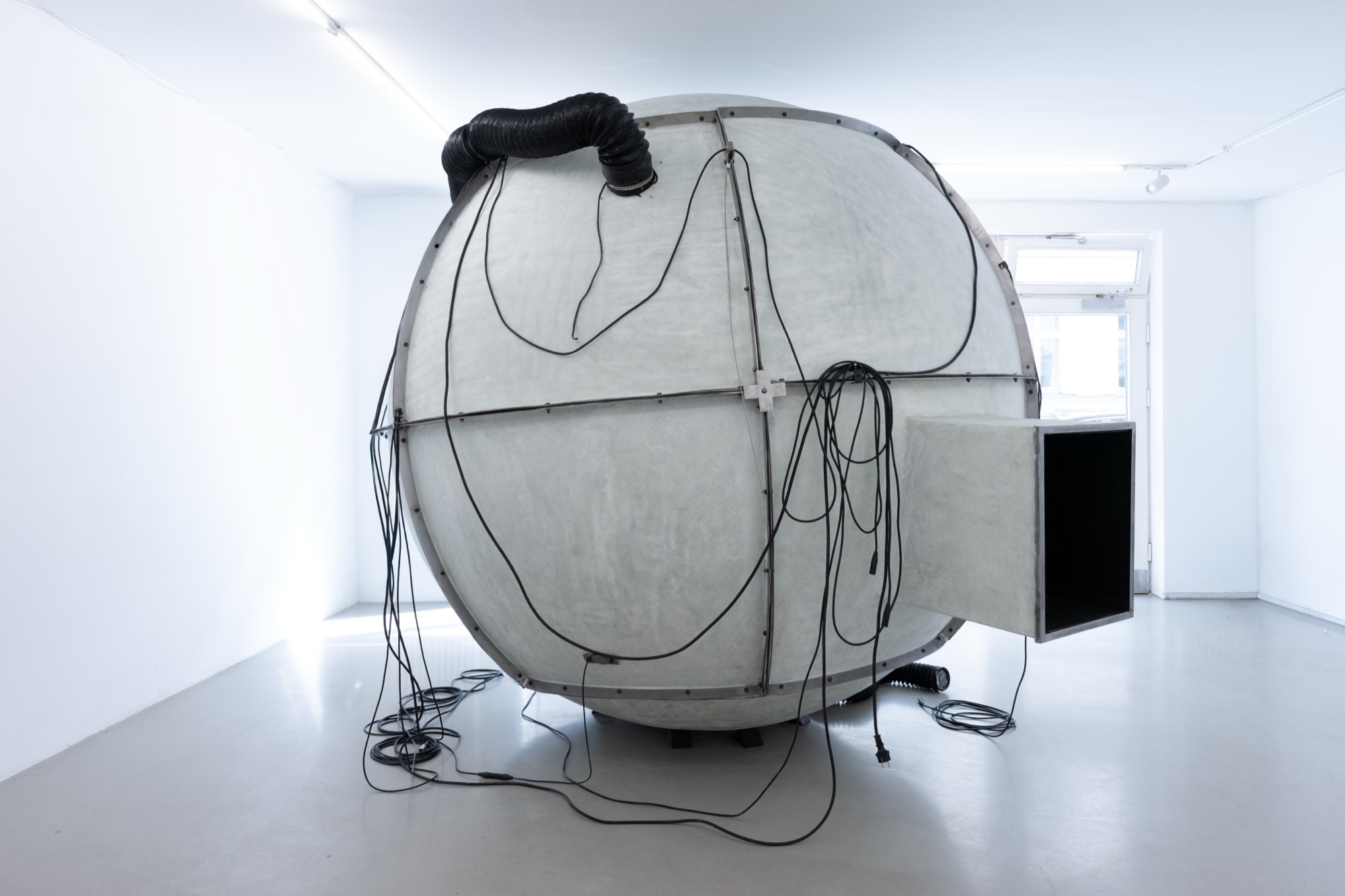
The solo exhibition Rhetorical Silence by Mathias Gramoso brings together a new body of work developed through an intensive seven-day experiment, where the artist lived isolated inside the total blackness of an enormous white sphere.
The American sociobiologist E. O. Wilson once observed of our contemporaneous species that we have paleolithic brains, medieval institutions, and godlike technology. Interestingly enough, he began as an ant taxonomist and developed a concept known as the taxon cycle: a theory of how a species changes when encountering a new habitat, like an island; expanding and contracting across time and place, evolving inevitably towards its eventual extinction. It goes something like this: an intrepid ant arrives in a new territory, a kingdom bounded by water that it besets and colonises. Eventually, its population specialises and fractures into smaller, more specialised communities, which, with time, grow so distinct that the original species can be considered extinct.
Likely, the ants are unmoved by this transgression; too busy, in the leaf litter and rock quarries, to care whether the descendants of the original colony could technically be considered the same species as their ancestors. But it is curious, returning to the neolithic hominid and his godlike technology, to think about our own intrepidness as a species and the possible annihilations we accelerate towards. Would the last human in any meaningful way recognise the first?
Not to insinuate that our more primitive and roaming iterations were necessarily more human, somehow, than 21st-century Berliners, but there appears still an observable yearning in our species, a keen and sharp nostalgia for a past. In many cases, what informs that nostalgia is a desire for the absence of technologies which now govern and surveil us. It is a longing for simpler tools.
Arrowheads which do not clandestinely listen to your calls. Compasses that lead you home, rather than to the port of the highest bidder. Not the endless screenworld of black mirrors which seek to demonically possess our every hour; every minute and every second, and whatever fractal that exists between them, ad nauseam. It is ironic, then, as remarked by Arthur C. Clarke, that any sufficiently advanced technology would be indistinguishable from magic, because yes, the tech which now suffuses our lives is magical. It has performed an impressive disappearing act by seemingly erasing temporality altogether. It cast a spell that flung us into an obliterating nowness, occupied by instantaneous apparitions and unhelpful sphinxes, as long as you pay for Go or Pro, that is.
It begs the question, then: when does a tool stop being a tool? At which point are we allowed to call technology a cage? And, once acknowledged as such, how do you free yourself from it? Rhetorical Silence suggests, as an intense and vulnerable proposition: if you cannot get out, then maybe you need to look for escape within. It is an uncompromising and frankly terrifying solution, yet blankly beautiful in the diametric yet dialectic relationship between the visual invasiveness of an attention economy and total sensory deprivation, a chasm where reams of reels, generated images and plastic surfaces give way to nothing: cleaved to pitch black.
By doing so, maybe paradoxically, Rhetorical Silence foregrounds the act of looking. It asks who peers back at you when you stare into the abyss. The answer is simple on the surface (and only there): It’s you. But what part of you are you seeing? You see the senses sensing; the machinery of perception itself: entoptic phenomena, phosphenes, and spontaneous visual patterns generated by the brain and visual system in the absence of external stimuli. But who shepherds these manifestations? A Virgilian spirit guide, descending a private Duat shaped by memory, expectation, attention, and prior experience. But again, why? Why surrender to such a crushing unknown? Why build an enormous fiberglass retina and gestate in it for a week? Why go where no one can follow you?
Because turning inward will allow you to return to the most primordial tool of all: the body. And to test the boundaries of what that body can experience; digging your hands into the unturned soil of the mind to see, even without light, what has been buried there. Because all your electronic devices isolate you from it. Because it is private and therefore non-monetisable; because it cannot be owned. Because it might lead you somewhere both very old and very new. Past the navel of the dream, where Sigmund Freud believed interpretation ran out and reverie touched something unconscious that can never be fully known or articulated.
Maybe we are naturally drawn to that unknown. It is after all one of our defining characteristics: that our species loves to wander, from mountain ridge to grassland, pole to pole. Perhaps that is also why we still utilize one of our oldest technologies: getting high. Tripping is a pastime shared by many otherwise unrelated civilizations, bound by the availability of organic hallucinogens. The reasoning for entering these interior worlds is manifold, from stabilizing cultural bonds through ritual to the countercultural act of breaking away from them, yet it does result in a kind of canon, from Celtic Druids consuming fly agaric and black nightshade to Aldous Huxley inducing sacramental visions with mescaline, itself derived from peyote, the flowering cactus revered and devoured by the Aztecs, and many others.
There are even archaeologists who believe that you can map constellations of societies that ceremonially consumed hallucinogenic plants by way of the symbols carved in tomb passages and etched on cave walls, since the documented geometries of such markings emerge from the brain while under the influence, independent of visual input. Mathias Gramoso would be part of this space-time continuum of psychonauts, albeit the drawings drawn from his visions in the series Phosphenes were produced without drugs. Rather, they were rendered via a physiognomic trial so intense it induced pretty much the same effect. And it delivered the artist to the same destination: the lifeworld of the brain and the eye.
The eye, particularly, remains a recurring visual thread throughout the show, framing it as a veil between worlds; a mediator between the phenomenal and the noumenal, both all-seeing and unreliable. The motif appears in the photo series Internal log, revealing the artist as a white pupil floating in a black cornea, as well as the wall sculpture Great Doubt, built from a panel from the spherical cell itself, where, through a peephole, visitors are invited to witness the isolatory ordeal. Recorded with a security camera from a bird’s eye view, it is a split investigation into the interiority of a private human as well as the broader societal structures which entrap and monitor us, where being seen is simultaneously a social requirement and a control mechanism used to weed out defects and dissent. Rhetorical Silence moves seamlessly between these vantage points; becoming eye-like, a yolky precipice where the artist can be both object and subject; existent on either side of the lens.
While some might be tempted to place the work squarely in performance art, this ultimately isn’t the art historical framework nor the narrative push of Rhetorical Silence. The sphere, named Exuviae in reference to the shed skin of a molting animal, speaks rather to the strange experience of being. What is it to be conscious? What are we when infrastructures peel away? It is back to the ant colony which can no longer recognize itself. Ask the ant: in your progress as a species and in your insistence that you must always go faster and further, what has been lost? Or, more radically and hopefully, where can it again be found?
The ant suggests: looking deep; looking beyond; looking within, invoking Henri Matisse’s observation that there are cathedrals everywhere, but only for those with eyes to see.